
Citing the national nutrition scorecard as both a warning and a call to action, the Nutrition Society of Nigeria has urged the government, non-governmental organisations, private enterprises and academia to work more closely to end malnutrition in the country, particularly among children under five.
The NSN said the call had become imperative following the poor nutrition indices reflected in the scorecard, disclosing that four in every 10 Nigerian children are stunted, eight per cent are wasted, almost half of women of reproductive age are anaemic, and only about one-third of women achieve minimum dietary diversity.
The society said the indices must drop if Nigeria is to achieve the Sustainable Development Goals by 2030.
The President of the NSN, Prof. Salisu Abubakar, raised the concerns alongside other stakeholders at the society’s 56th Annual Scientific Conference and General Meeting in Lagos, themed “Delivering Better Nutrition for All: Connecting the Dots Across Life Cycle, Systems, and Sectors.”
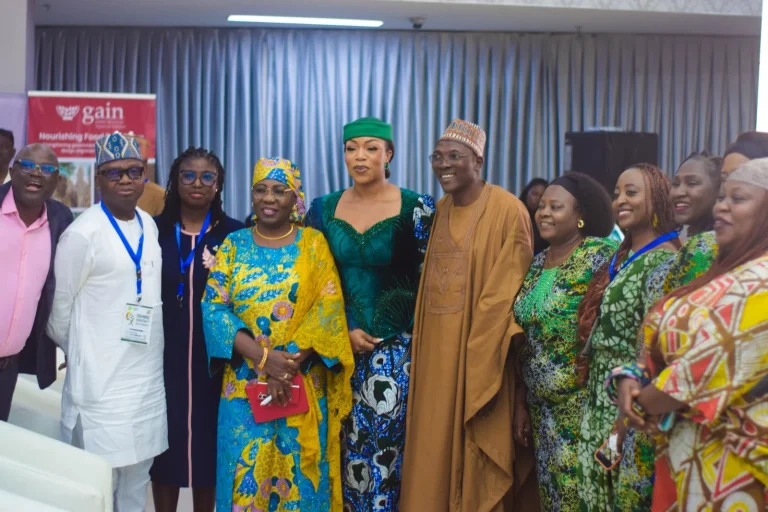
The conference brought together top government officials, researchers, nutrition experts, development partners, academia, prominent traditional rulers, including the Emir of Kano, Khalifa Muhammadu Sanusi II, and representative of Vice President Kashim Shettima.
In his welcome address, Abubakar told participants that Nigeria continued to face malnutrition in all its forms.
He noted that addressing the challenge required stakeholders to deliberately connect life-cycle interventions, particularly in health, food, education, social protection, and water, sanitation, and hygiene systems, to change the narrative.
The NSN president stressed the need to build partnerships among stakeholders to accelerate progress in addressing malnutrition in Nigeria’s current nutrition situation, adding that many Nigerians were experiencing acute food insecurity.
“Our national nutrition scorecard is both a warning and a call to action. Four in every 10 Nigerian children are stunted, eight per cent are wasted, almost half of women of reproductive age are anaemic, and only about one-third of women achieve minimum dietary diversity.
“Our complementary feeding indicators remain deeply concerning, while food insecurity continues to affect a very large proportion of our population.
“These realities place Nigeria considerably off the trajectory required to achieve the World Health Assembly Nutrition Targets and SDG 2.2 by 2030,” the don said.
The nutritionist, however, noted that the figures were not only a cause for concern but also a call to action with an opportunity to identify what must be done to reverse the negative trend.
Abubakar said, “The evidence tells us exactly what must change: we must connect the dots across the life course, connect nutrition-specific and nutrition-sensitive interventions, connect food systems with health systems, connect evidence with policy and implementation, and connect government leadership with the capabilities of academia, professional bodies, communities, civil society and the private sector.
“Nigeria’s latest nutrition evidence presents a mixed but unmistakable picture. We are seeing encouraging signs in the reduction of wasting and underweight, with wasting now estimated at 4.7 per cent in the 2025–26 Mini-DHS. Yet chronic malnutrition remains deeply entrenched: 41.1 per cent of our children under five are stunted, and 19.2 per cent are severely stunted.”
The professor disclosed that the burden of malnutrition was even more profound in the North-West, where 58.2 per cent of children are stunted.
He said, “At the same time, our National Food Consumption and Micronutrient Survey continues to remind us that hidden hunger, particularly deficiencies of vitamin A, zinc and folic acid, remains a major national concern, while coverage of micronutrient interventions remains inadequate.
“These findings tell us that Nigeria does not need one nutrition solution; we need a connected nutrition response across the life course, systems and sectors.”
For him, the challenge before Nigeria is no longer simply to reduce malnutrition.
“It is to transform the systems that produce malnutrition, so that every Nigerian, regardless of where they live, their income, age or gender, can access a safe, affordable, diverse and nutritious diet and the services required to achieve optimal nutrition,” he said.
He stressed the need to partner with the private sector in ending all forms of malnutrition in Nigeria.
According to him, the event provided a unique opportunity to reflect, share evidence and chart actionable pathways to ensure all Nigerians, across every stage of life, are adequately nourished.
Abubakar further told the gathering that Nigeria’s nutrition profile demanded full and urgent attention of stakeholders, citing recent global statistics on the country’s nutrition performance.
“In the 2025 Global Hunger Index, Nigeria scored 32.8 and ranked 115th of 123 countries assessed—a level of hunger classified as ‘serious.’
“Our National Bureau of Statistics reports that 133 million Nigerians, representing 63 per cent of our population, live in multidimensional poverty, with inadequate nutrition counted among the very deprivations that define it.
“UNICEF ranks Nigeria second in the world for the sheer number of children living with stunted growth, and records that of the nearly two million Nigerian children currently living with severe acute malnutrition, only two in every 10 are being reached with treatment,” he stated.
The don, however, acknowledged ongoing efforts to address malnutrition in Nigeria and commended the Federal Government’s support and commitment to improving the country’s nutrition indices.
This year alone, he said, the National Council on Nutrition adopted the National Policy on Food and Nutrition, 2026 to 2035, which is now awaiting ratification by the Federal Executive Council, alongside the continued rollout of the Nutrition 774 Initiative to every local government in the federation.
“We commend, in particular, the progress of the Nutritionists Registration Council of Nigeria Bill, which has scaled its second reading at the National Assembly and now awaits the diligence of the committee, a legislative milestone that will, for the first time, give statutory protection to our profession,” he noted.
Abubakar affirmed that ending malnutrition in Nigeria would require innovation, strong partnerships and commitment of every sector, assuring that Nigeria has the potential to make it happen.
The professor concluded, “Together, we can build a healthier, stronger and more prosperous Nigeria by connecting the dots across the life cycle, our systems and our sectors, and by so doing, contribute meaningfully to Nigeria’s development and the achievement of the Sustainable Development Goals.”
In his remarks, Shettima, represented by his Senior Special Assistant on Public Health and Focal Person on Nutrition, Mrs Uju Rochas-Anwukah, said Nigeria’s nutrition problems were interconnected and required a multisectoral approach.
The Vice President stressed the need for stronger coordination across sectors and levels of government.
Speaking, the Chairman of the NSN Board of Trustees and Emir of Kano, Muhammadu Sanusi II, said Nigeria faces an acute nutrition challenge that requires stronger investment, coordination and accountability across government and the private sector.
Sanusi said the latest Nigeria Mini-Demographic and Health Survey 2025–26 showed that 41.1 per cent of children under five were stunted, while 19.2 per cent were severely stunted.
He said the situation was worse in the North-West, where 58.2 per cent of children were stunted, adding that only 25.3 per cent of children under five received any iron-containing supplements in the past year.
“These figures should not discourage us; they should guide us. Data must be translated into decisions, budgets and programmes that reach those who need them,” he added.
Source: PUNCH