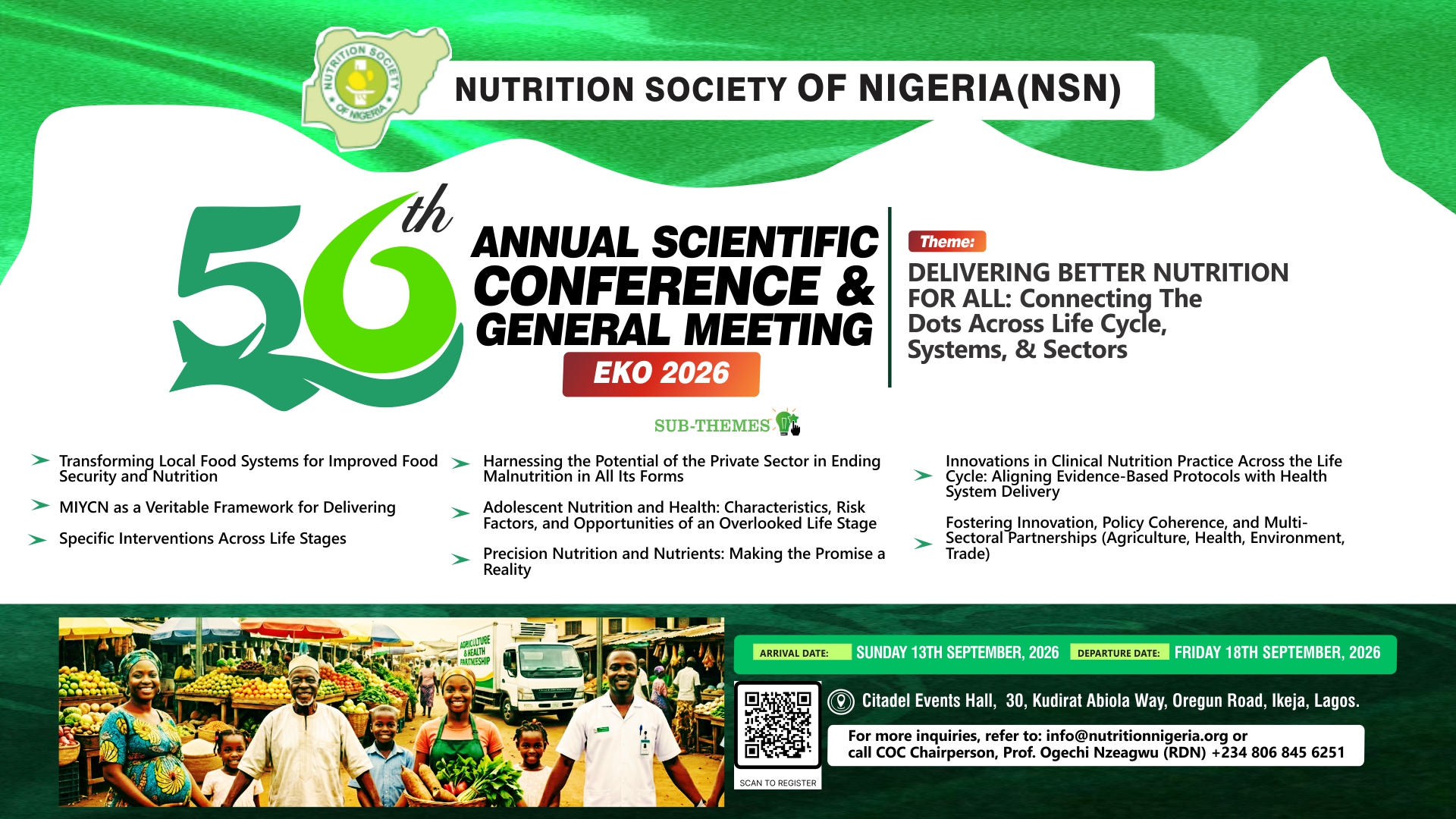
Location: Citadel Events Hall, 30 Kudirat Abiola Way, Oregun Road, Ikeja, Lagos State, Nigeria
Date: 14th to 17th September, 2026
Theme: “Delivering Better Nutrition for All: Connecting the Dots Across Life Cycle, Systems, and Sectors.”
PREAMBLE
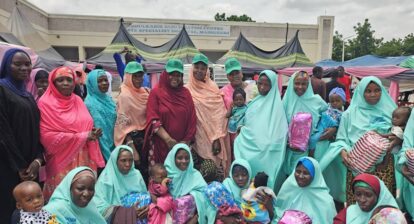
The Nutrition Society of Nigeria (NSN) held its 56th Annual Scientific Conference and General Meeting. The Conference brought together over 1,500 nutritionists, dietitians, public health professionals, food scientists, researchers, policymakers, development partners, industry stakeholders, students, and other allied professionals committed to advancing nutrition science, practice, policy, and national development.
The conference featured a pre-conference workshop, opening ceremony attended by dignitaries including His Highness Muhammad Sanusi II, CON, PhD, Emir of Kano and Chairman of the Board of Trustees of the NSN; the Chairman House Committee on Nutrition and Food Security; the Executive Governor of Katsina State (represented by his Deputy); and the Vice President of the Federal Republic of Nigeria (represented by the Senior Special Assistant to the President on Public Health). The keynote address was delivered by Dr. Mansur Mukhtar (Chairman of the Board of Bank of Industry, Member of the Scaling Up Nutrition (SUN) Movement Lead Group, and former Minister of Finance). This was followed by plenary and technical sessions, scientific oral and poster presentations, panel discussions, award and recognition ceremonies, induction of Fellows and new members, the Aliko Dangote Foundation-NSN Inter-school Nutrition Debate, and the Annual General Meeting.
KEY OBSERVATIONS
- Nutrition remains central to Nigeria’s human capital development, public health outcomes, educational attainment, economic productivity, family welfare, social protection, and national prosperity.
- Nigerians continue to experience malnutrition in multiple forms, including stunting, wasting, underweight, micronutrient deficiencies, and diet-related non-communicable diseases.
- Addressing malnutrition requires a coordinated life-cycle approach, encompassing maternal nutrition, infancy and young child feeding, childhood, adolescence, adulthood, and the elderly.
- Effective nutrition action requires stronger connections across systems and sectors, including health, agriculture, education, social protection, women’s affairs, WASH, food safety and regulation, research, industry, climate resilience, and community development.
- The Conference deliberations highlighted the importance of local food systems, maternal, infant and young child nutrition (MIYCN), private-sector engagement, adolescent nutrition, precision nutrition, clinical nutrition practice, policy coherence, governance, accountability, and multisectoral partnerships.
- Current national efforts and policy opportunities, including the National Policy on Food and Nutrition 2026-2035, Nutrition 774 (N774) initiative, State Councils on Nutrition, micronutrient supplementation, food fortification, the National Community Food Bank Trust Fund, biofortification, and legislative attention to the nutrition profession (including the establishment of the Nutritionists Registration Council of Nigeria and the National Nutrition Bill), provide opportunities for accelerated progress.
- Traditional and faith leaders, community gatekeepers, professional bodies, academia, civil society, development partners, and the organized private sector remain essential to translating nutrition policies and programmes into meaningful household- and community-level impact.
- Adolescents and young people are critical agents of change in advancing nutrition awareness, advocacy, leadership, communication, and healthy dietary practices.
- Existence of unhealthy food environments in schools, lack of preconception nutrition clinics, and pre-pregnancy micronutrient supplementation (especially folic acid) and late commencement of ANC among pregnant women contribute to a high prevalence of anaemia and poor pregnancy outcomes.
- The Annual Inter-school Nutrition Debate initiative supported by the Aliko Dangote Foundation (ADF) in collaboration with the NSN presents an opportunity for youth engagement and improved nutrition outcomes in Nigeria, especially in the school environment.
RECOMMENDATIONS
- NSN and stakeholders should intensify investment in nutrition science, drive policy implementation, financing, governance, accountability, professional regulation, and evidence-based programming.
- Government at all levels should accelerate implementation of the National Policy on Food and Nutrition 2026-2035 and strengthen coordination platforms that translate national commitments into measurable results at state, local government, ward, and community levels.
- Nutrition interventions should be planned and delivered across the life cycle, with increased attention to maternal nutrition, infant and young child nutrition, school-age children, adolescents, women of reproductive age, and older persons.
- Government, development partners, the private sector, and other relevant stakeholders should strengthen food systems that deliver safe, affordable, diverse, nutritious, culturally acceptable, and sustainable diets through local food systems transformation, large-scale food fortification, biofortification, food safety, food labelling, climate resilience, and reduction of post-harvest losses.
- Nutrition governance should be strengthened through improved data systems, performance-monitoring dashboards, research translation, implementation science, and routine use of evidence to inform policy and programme decisions.
- The private sector, philanthropic institutions, development partners, civil society, academia, professional associations, and communities should deepen collaboration to address financing gaps and expand scalable, high-impact, and cost-effective nutrition interventions.
- Government, in collaboration with partners, should strengthen community-based delivery platforms, including social and behaviour change, women’s empowerment, homestead food production, community nutrition education, and linkages with health facilities.
- Government, in collaboration with relevant partners, should increase awareness of preconception nutrition, support the establishment of preconception clinics, and strengthen appropriate pre-pregnancy micronutrient supplementation. This should also include intermittent supplementation of adolescent girls with multiple micronutrient supplements (MMS) or iron and folic acid, as appropriate.
- The Federal Ministry of Education (FMOE) in collaboration with relevant stakeholders should institutionalize and support the National Senior Secondary School Nutrition Debate Competition as a strategic platform for youth nutrition advocacy, leadership development, and school-based nutrition education.
- Relevant Federal and State Government Ministries, Departments, and Agencies should ensure that nutrition departments are established and adequately staffed.
- The Nutrition Society of Nigeria calls for a shift from fragmented nutrition interventions to coordinated, measurable, and accountable actions capable of improving nutrition outcomes and saving lives across Nigeria.
CALL TO ACTION
The Nutrition Society of Nigeria calls on the Federal, State, and Local Governments; organized private sector, development partners; civil society and philanthropic organisations/foundations, academia and research institutions; professional bodies; traditional and faith leaders; media organisations; and communities to move beyond declarations of commitment and translate evidence and policy commitments into coordinated, adequately funded, and measurable action to address malnutrition in all its forms. The Society urges all stakeholders to accelerate implementation of the National Policy on Food and Nutrition 2026-2035 through its multisectoral plan of action; strengthen Nutrition 774 and State Councils on Nutrition; expand investment in maternal, infant, young child, adolescent, and women’s nutrition; scale up large-scale food fortification, biofortification, food safety, and food labelling interventions; strengthen community-based nutrition education and social and behaviour change communication; and support youth nutrition advocacy through school-based platforms.
CONCLUSION
The Nutrition Society of Nigeria reaffirms that good nutrition is fundamental to human survival, health, cognitive development, productivity, economic growth, and national development. The Society remains committed to advancing nutrition science through research, strengthening professional capacity, promoting evidence-based advocacy, supporting national policy implementation, and fostering multisectoral partnerships that deliver practical solutions for households and communities. This will ensure a turning point for action, accountability, partnership, and measurable progress towards a healthier, better-nourished, and more productive Nigeria. The Conference reaffirmed that ending malnutrition in Nigeria requires innovation, strong partnerships, accountable systems, and sustained commitment across all sectors and throughout the life cycle. From EKO 2026, the message is clear: Nigeria must connect the dots across life cycle, systems, and sectors to deliver better nutrition for all.
Signatories:
- Professor Salisu Maiwada Abubakar, FNSN
(President, Nutrition Society of Nigeria) | Email: president@nutritionnigeria.org - Dr. Oluwaseun Ariyo
(National General Secretary, NSN) | Email: NatGenSecretary@nutritionnigeria.org
(This publication is supported by the Development Research and Project Centre (dRPC))