
The Minister of Innovation, Science and Technology, Dr. Kingsley Udeh has pledged the Federal Government’s support and commitment to the Grand Challenge Nigeria (GCNg) project, emphasizing its impact-driven and solution-driven nature to improve healthcare delivery and benefit citizens.
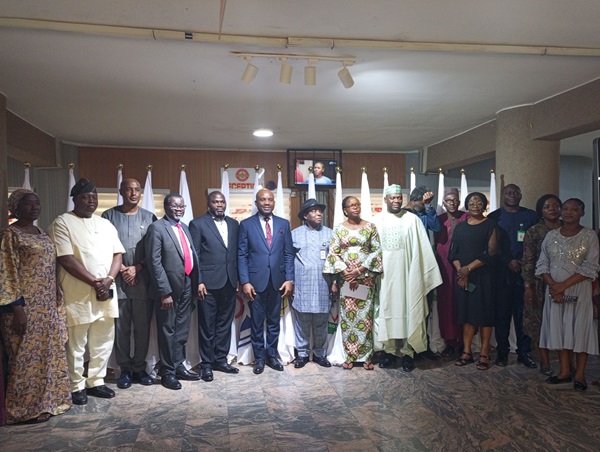
The minister reaffirmed this during a courtesy visit with Grand Challenge Nigeria held in Abuja, as he addressed research commercialization and funding for the initiative.
The programme director, Godwin Bamsa shared updates on the programme’s progress and plans during the visit to the Federal Ministry of Innovation, Science and Technology.
The visit aimed to highlight the FMIST partnership, showcase Maternal, Newborn and Child Health (MNCH-RFP) investment progress and early results, emphasizes readiness for scale and initiate structured engagements for adoption and introduction to the 2026 Climate and Health Global Challenge.
Bamsa revealed that Nigeria is poised to join a global $150m+ 2026 Climate and Health Initiative, which targets infectious diseases and food systems with grants ranging from $200,000 to $2m. Whilst other African nations have pledged funds, Nigeria’s FMIST needs to commit a minimum investment of $200,000.
He explained that Grand Challenges Nigeria was launched in 2024 with support from the Office of the Vice President and the Federal Ministry of Innovation, Science and Technology.
The programme has funded 9 innovators with nearly N60 million each to develop proof-of-concept solutions. After 5 months, early results are promising and the team shared these with the Ministry whilst discussing plans for scaling projects and new investments.
The programme director highlighted that the Grand Challenges framework addresses development issues by crowdsourcing local innovations to solve difficult problems. Since joining the global Grand Challenges network in 2024, the programme has worked with stakeholders and the government to define priorities in health and food security. Current investments focus on maternal, newborn and child health, yielding results in machine learning, devices and primary healthcare systems, saving lives within months.
Grand Challenges Nigeria operates on three pillars: defining challenges by working with stakeholders and government to identify priority areas for innovation; directing innovation resources by providing funding, technical capacity and policy support to unlock solutions, with proof-of-concept grants of up to 60 million Naira per team; and commercialization and adoption, ensuring innovations achieve impact quickly through uptake by institutions and scale funding.
According to Bamsa, the investments span nearly all geopolitical zones in Nigeria, ensuring inclusive innovation support. He emphasised the programme’s commitment to impact-driven innovation, aiming to contribute to development quickly and effectively.
In response, Udeh enquired about the development status of the nine Grand Challenges Nigeria projects, noting they are research grants whilst underscoring the ministry’s core priorities around energised commercialisation.
It was confirmed that all projects are currently in the proof-of-concept stage, with each grantee receiving up to ₦60 million. This initial phase spans 12 to 15 months and includes testing, some of which are clinical trials. The next stage, scale-up funding, is anticipated around October this year and will be executed in partnership with various institutions. No projects are currently at a scalable level, but promising outcomes are already being observed.
The Grand Challenges model is that each challenge is government-owned, providing core funding whilst the network mobilizes matched funds. For initiatives like the upcoming Climate and Health, a minimum government contribution of $200,000 USD is required, which will be matched one-to-one by partners like the Gates Foundation.
This means for every project the government funds, the network funds another. For the current Maternal, Neonatal and Child Health (MNCH) projects, both seed and scale-up funding have already been secured from the Gates Foundation as part of a model to prove efficacy for government adoption.
Udeh acknowledged the critical timing of funding discussions, noting that budget cycles require such conversations to happen much earlier, for example, in November for the 2026 budget. Whilst the 2026 budget cycle for federal government funding may be missed, the Climate and Health portfolio is a five-year initiative, offering opportunities for future inclusion.
The Federal Ministry of Innovation, Science and Technology retains ownership and flexibility to define additional portfolios beyond health, focusing on national priorities, with partners ready to match funding.
The minister emphasized that none of the research outcomes would be left on shelves, aligning with presidential priorities for sustainable economic growth and job creation.