
INTRODUCTION
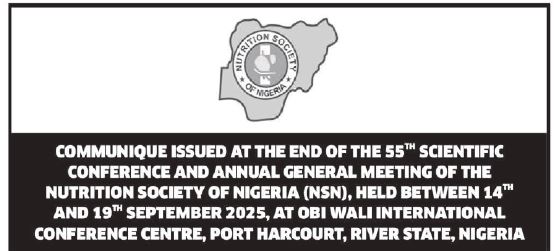
The 55th Scientific Conference and Annual General Meeting of the Nutrition Society of Nigeria (NSN) was held at the Obi Wali International Conference Centre, Port Harcourt, Rivers State, with the theme “Advancing Maternal, Infant and Young Child Nutrition (MIYCN) in Nigeria: Innovations and Strategic Partnership for Sustainable Impact from 14th to 19th September 2025. It had in attendance over 973 delegates from Academia, Industry, Government, Research Institutes, Media, Civil Society, Development Partners, International and UN Agencies, which included 372 newly inducted NSN members. The conference featured high-level plenary sessions, panel discussions, and, poster and technical parallel sessions.
OBSERVATIONS
At the end of the 4-day robust deliberation and ensuing contributions, participants observed as follows:
1. There is an unacceptable rise in malnutrition, a reversal of previous progress, and a high proportion of households that are food insecure, thereby posing a great challenge to meeting the global and national nutrition targets.
2. In recent years, we have witnessed escalating food insecurity coupled with inadequate health care infrastructure, security challenges and disease outbreaks worsened by low vaccine coverage, resulting in one of Nigeria’s worst nutrition emergencies in decades.
3. Malnutrition has different underlying causes and needs to be addressed through interventions across different sectors and the lifecycle.
4. While the ongoing efforts of the government to improve the nutrition of mother and child through Maternal Infant and Young Child Nutrition are commendable, the needed capacity development for the workforce, enabling environment and adequate financial resources for procurement of nutrition materials, equipment and commodities are not yet optimal.
5. While multisectoral platforms exist, the implementation of projects and interventions, including Maternal, Infant and Young Child Nutrition among various stakeholders, is still irregular and poorly coordinated.
6. Despite the availability of food and nutrition (including MIYCN) policy, strategy, related documents and guidelines, and emerging enabling environment and opportunities, there is a paucity of innovative research, tailored to address the lingering causes of food and nutrition insecurity in our communities.
7. Understanding the fact that food and nutrition crises, including malnutrition in all its forms, occur at the community level, nutrition stakeholders are yet to maximize the community’s enormous potential, harness its resources and sufficiently engage community structures for better nutrition outcomes.
8. Maternal, Infant and Young Child Nutrition is a shared responsibility, whose success is not measured by the policies written in the papers but in the lives they transform. However, the investment in nutrition interventions is yet to produce the desired results.
9. Where nutrition data are available, they are weak and non-utilizable for planning and implementing programmes at sub-national levels.
RECOMMENDATIONS
The Nutrition Society of Nigeria, having considered the observations made, hereby recommend as
follows:
1. Nutrition Society of Nigeria will continue high-level advocacy to the government and all stakeholders to increase investment in achieving food and nutrition security.
2. The Nutrition Society of Nigeria will hold the government accountable for the delivery of Nutrition for Growth (N4G) summit commitments.
3. The National Council on Nutrition should ensure the integration of nutrition interventions into the plans of all relevant Ministries, Departments and Agencies of government at all levels.
4. Government should ensure that graduates of Nutrition and Dietetics are employed to head the Nutrition Departments of the relevant Ministries, Departments and Agencies.
5. Government and partners should continue to empower healthcare providers with relevant skills and knowledge, and motivate them with the supply of equipment, nutrition commodities and materials.
6. The National Council on Nutrition should ensure proper coordination of the various multisectoral platforms and plans by holding Ministries, Departments and Agencies accountable for the delivery of nutrition interventions under their portfolio.
7. Nutrition Society of Nigeria will put in place a research agenda focused on innovations to address food and nutrition security challenges in Nigeria.
8. Government and partners should continue to engage community structures in planning and implementation of nutrition interventions, especially the Nutrition 774 (N-774) Initiative.
9. Government at all levels, in partnership with nutrition stakeholders, should scale up community-driven, gender-centered (men and women) approaches to nutrition interventions.
10. All nutrition stakeholders should leverage technology, from mobile messaging platforms that guide mothers through each stage of infant feeding, to digital supply chain systems that prevent stock-outs of essential nutrition commodities as well as data management.
11. The National Council on Nutrition should coordinate with relevant Ministries, Departments, and Agencies to foster collaboration among Nutritionists, Health care providers, Researchers, Farmers, Manufacturers, Supply chain specialists, Policy makers and Development partners to synergistically tackle malnutrition and create a more sustainable and equitable future for all.
12. Government to ensure harmonization of various existing nutrition dashboards based on the multisectoral nutrition data framework.
13. The government, in collaboration with partners, should invest in capacity building on data literacy for nutrition and health professionals.
14. The government should strengthen the provision of an enabling environment and engage the organized private sector for the effective implementation of nutrition interventions in Nigeria.
Signed:
Executive Council
Nutrition Society of Nigeria