

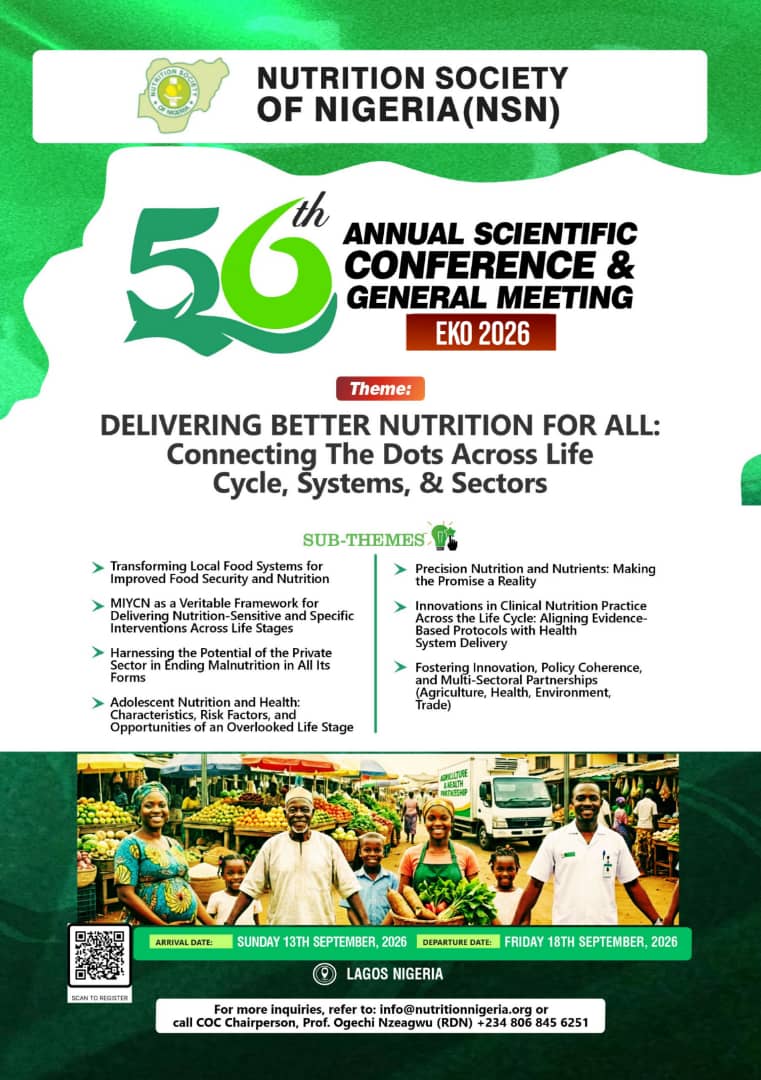
The Nutrition Society of Nigeria invites Nutritionists, Dietitians, Food Scientists and other related professionals from Tertiary Institutions, Health Institutions, Research Institutes, Government Ministries, Departments and Agencies, Industries, Development Partners and Organized Private Sector and Non-Governmental Organisations (NGOs) to its 56th Annual General Meeting and Scientific Conference scheduled to hold in Lagos, Nigeria.
THEME
DELIVERING BETTER NUTRITION FOR ALL: Connecting The Dots Across Life Cycle, Systems, & Sectors.
SUB THEME
- Transforming Local Food Systems for Improved Food Security and Nutrition
- MIYCN as a Veritable Framework for Delivering Nutrition-Sensitive and Specific Interventions Across Life Stages
- Harnessing the Potential of the Private Sector in Ending Malnutrition in All Its Forms
- Adolescent Nutrition and Health: Characteristics, Risk Factors, and Opportunities of an Overlooked Life Stage
- Precision Nutrition and Nutrients: Making the Promise a Reality
- Innovations in Clinical Nutrition Practice Across the Life Cycle: Aligning Evidence-Based Protocols with Health System Delivery
- Fostering Innovation, Policy Coherence, and Multi-Sectoral Partnerships (Agriculture, Health, Environment, Trade)
|
Activity |
Timeline |
|
Submission of Abstracts |
On or before 31st July 2026. |
|
Notification of Acceptance of Abstracts |
By 31st August, 2026 |
|
Arrival/Registration |
Sunday 13th September, 2026 |
|
Pre-conference Workshop/Registration |
Monday 14th September 2026 |
|
Official Opening/Registration |
Tuesday 15th September 2026 |
|
Symposia/Plenary Sessions/Technical Sessions |
Wednesday 16th September 2026 |
| Plenary Sessions/Technical Sessions |
Thursday 17th September 2026 |
|
Plenary Sessions/Technical Sessions/AGM/Closing |
Thursday 17th September 2026 |
|
Departure |
Friday 18th September 2026 |
|
Category |
Deadline |
Fee |
|
NSN MEMBERS |
||
| Early Bird – Individuals |
31st July 2026 |
₦55,000 |
| Late Registration – Individuals |
1st August to 10th September 2026 |
₦75,000 |
| *Onsite Registration – Individuals |
14th to 19th September 2026 |
₦100,000 |
| NSN Student members |
31st August 2026 |
₦40,000 |
| **NSN Corporate members |
1st August to 13th September 2026 |
₦450,000 |
|
NON – NSN MEMBERS |
||
| Individual Non-Members | 1st August to 13th September 2026 |
₦90,000 |
| **Corporate Non-Members |
1st August to 13th September 2026 |
₦550,000 |
| International Delegates | 1st August to 13th September 2026 |
$300 |
*No cash will be accepted
**Admits a maximum of two participants
Click here to register for Conference
CITATION OF FELLOWS
1. Prof. Oluwatosin Benedict Adu
2. Dr. Ogechi Akalonu
3. Dr. Victor Effiong Bassey
5. Dr. Chioma-Emma Nwachukwu
6. Ogbonna Cyprian Nwiboko
7. Prof. Ogechi Chinyere Nzeagwu
8. Prof. Olumuyiwa Adeyemi Owolabi
GOOWILL MESSAGE
We welcome extended and structured abstracts that are in line with the theme and sub-themes of the conference. The abstract should be typed in a Microsoft Word document of not more than 2 pages of A4 paper size. Line spacing should be 1.5 points but single (1.0) line spacing can be used for tables if necessary. Times New Roman and font size 12 should be used. The page margins should be set at Normal (Top = 2.35cm, Bottom = 2.54cm, Left = 2.54cm and Right = 2.54cm). Authors are strongly advised to follow the abstract template and submission procedures available at GUIDELINES FOR SUBMISSION OF EXTENDED ABSTRACT
Please be informed that only authors who have completed their conference registration will have their accepted abstracts scheduled for presentation during the conference and included in the Book of Abstract Proceedings.
Authors with accepted abstracts are kindly advised to complete their registration within the stipulated deadline to secure presentation and publication opportunities.
Thank you for your cooperation, and we look forward to your participation.
Abstract Submission Procedure:
1. Send your abstract as an email attachment to abstractpots@nutritionnigeria.org
2. Use the Sub-theme of your abstract as the subject of the email
Please ensure your submission aligns with the conference guidelines and is sent before the deadline.
Authors of accepted abstracts who are interested in submitting full paper for publication in the Nigerian Journal of Nutritional Sciences (NJNS) should contact the Editor-In-Chief via njns2013@gmail.com and/or visit https://www.ajol.info/index.php/njns for details.
We look forward to your valuable contribution.
Food and allied industries, development partners, tertiary institutions, non-governmental organisations, and individuals are invited to exhibit their products and services. All inquiries should be directed to the COC through the official email address for the conference: nsnconference@nutritionnigeria.org
| HOTELS | ROOMS | PRICES PER NIGHT | LOCATION/CONTACT INFORMATION |
| ETAL HOTEL & HALLS | STANDARD | 30,000 |
Adjacent plot 30 Kudirat Abiola way, Oregun, Lagos Nigeria.
Close to the Conference center |
| EXECUTIVE | 35,000 | ||
| SUPER EXECUTIVE | 40,000 | ||
| DELUX SUITE | 50,000 | ||
| DIPLOMATIC SUITE | 60,000 | ||
| THE DOVER HOTEL | SUPERIOR STANDARD | 150,000 |
14 Aromire street off Allen Avenue, Ikeja Lagos. Tel nos:08036289680 08032470412,07033634776 07061543112 |
| EXECUTIVE STANDARD | 200,000 | ||
| EXECUTIVE SUITE | 350,000 | ||
| PRESIDENTIAL SUITE | 500,000 | ||
| IVY AROMIRE | SUPERIOR | 55,000 |
13 Aromire Avenue off Adeniyi Jones by Allen Junction Ikeja Lagos. Call:07030389937 Whatsapp:09098888856 |
| DELUXE | 65,000 | ||
| EXECUTIVE | 70,000 | ||
| PREMIUM CLASS | 85,000 | ||
| IVY SUITES | 100,000 | ||
| LI TOUR INTER.HOTEL | STANDARD | 75,000 |
54 Adeniyi Jones, Ikeja Call:08062394242 |
| SUPERIOR | 90,000 | ||
| DELUXE | 120,000 | ||
| LUXURY SUITE | 150,000 |
| HOTELS | ROOMS | PRICES PER NIGHT | LOCATION/CONTACT INFORMATION |
| GALPIN SUITES | STANDARD | 36,000 |
JAFAC close off Alhaji Jimoh street Aco bus stop, Adeniyi jones,Ikeja Call:09038618782,08051454983 G.M 08153199402 |
| DELUXE | 40,000 | ||
| SUPER DELUXE | 48,000 | ||
| DIPLOMATIC SUITES | 63,000 | ||
| IVY HOTEL | STUDIO | 23,000 |
131,Obafemi Awolowo way,Oba Akran Ikeja Call:08168579824 |
| CLASSIC | 28,000 | ||
| STANDARD | 29,000 | ||
| LUXURY | 31,000 | ||
| PREMIUM | 33,000 | ||
| DELUXE | 34,000 | ||
| EXECUTIVE | 41,000 | ||
| EXECUTIVE ROYAL | 48,000 | ||
| SUPREME SUITES | 55,750 | ||
| JUNIOR SUITES | 60,000 | ||
| DE REMRANDT HOTEL AND SUITES | POOL SIDE | 40,000 |
172 Obafemi Awolowo way,Alausa,Ikeja,Lagos Tel no:08065505845/08029555640 Whatsapp:08065505845 |
| 004 POOL SIDE | 50,000 | ||
| MINI STANDARD | 55,000 | ||
| STANDARD ROOM | 78,000 | ||
| MINI SUITE | 100,000 | ||
| FAMILY ROOM | 156,000 | ||
| EXECUTIVE SUITE | 128,000 | ||
| PRESIDENTIAL SUITE | 168,000 | ||
| PROTEA HOTEL MARRIOT IKEJA SELECT |
A ROOM (best to be booked via their website) |
233,469.50 |
Plot 2 Assibifi road,Ikeja Tel no:08139843800
|
| HOTELS | ROOMS | PRICES PER NIGHT | LOCATION/CONTACT INFORMATION |
| HADMOF HOTEL | STANDARD | 64,500 |
8, Kaffi Street, Beside ShopRite, Alausa Ikeja, Lagos. Tel.no:09038443383/07030026130/ 09083157236 |
| DELUXE | 80,625 | ||
| SUPER DELUXE | 91,375 | ||
| EXECUTIVE | 118,250 | ||
| SUPER EXECUTIVE | 139,750 | ||
| VIP SUITE | 193,500 | ||
|
THE AUTOGRAPH HOTEL AND APARTMENTS (EXECUTIVE) |
PARIS | 79,950 |
24, Iyalla street off kaffi street, beside ShopRite Alausa, Ikeja, Lagos. Tel.no:08077670550 |
| LONDON, LOS ANGELES AND MIAMI | 66,950 | ||
| TORONTO | 56,450 | ||
| AUSTRALIA | 66,950 | ||
| GERMANY | 99,000 | ||
| AMSTERDAM | 66,950 | ||
|
THE AUTOGRAPH HOTEL AND APARTMENTS (BASIC) |
TRANSIT | 26,500 |
3, Iyalla street off Kaffi street, Beside ShopRite Alausa, Ikeja, Lagos. Tel.no:08077670570 |
| TRANSIT BUDGET | 31,500 | ||
| STANDARD | 36,500 | ||
| EXECUTIVE SUITE | 69,950 |
| Area | Hotel | Approx. Rate (₦/Night) | Contact | Address | Rating |
| Ikosi-Ketu | Spanish Hotel | 30,000–35,000 | +234 802 285 3558 | 4 Obajimi Close, Ikosi-Ketu | ⭐ 4.5 |
| Ikosi-Ketu | First Colony Creek Hotel | 30,000–40,000 | +234 903 829 3737 | 13 Alh. Yekini Aromolate Street | ⭐ 4.0 |
| Ikosi-Ketu | Ambience Hotel Ikosi | 25,000–35,000 | +234 913 727 9173 | 11 Ogunlana Street | ⭐ 4.3 |
| Ikosi-Ketu | Q10 Suites & Lounge | 30,000–45,000 | +234 810 878 3007 | 7 CMD Road | ⭐ 4.0 |
| Ikosi-Ketu | Boyemco Hotel | 5,000–15,000 | +234 704 195 6318 | 4 Atinmo Street | ⭐ 3.5 |
| Ikosi-Ketu | Bakky Fasal Guest House | 5,000–10,000 | Contact at reception | Bello Folawiyo Crescent | ⭐ 3.3 |
| Ikosi-Ketu | J & J Hotel and Lounge | 20,000–35,000 | +234 803 919 8460 | Love-All Street, Cele Bus Stop | ⭐ 3.9 |
| Ketu | Hotel Paulson Plaza | 20,000–25,000 | +234 708 061 4272 | 8 Anibaba Street | ⭐ 3.8 |
| Ketu | Sunnyside Hotel & Suites | 25,000–35,000 | +234 909 374 2229 | 494 Ikorodu Road | ⭐ 3.3 |
| Ketu | Pearlwood Hotel | 25,000–40,000 | +234 705 445 1000 | 17 Ajiboye Street | ⭐ 4.0 |
| Ojota | Aotel DawnCarrington Hotels & Suites | 25,000–35,000 | +234 707 565 1770 | 6 Emmanuel High Street | ⭐ 3.6 |
| Agege | Guinness Guest House* | 15,000–25,000 | Contact to be confirmed | Agege | Budget |
| Agege | Choice Hotel Agege* | 25,000–35,000 | Contact to be confirmed | Agege | Mid-range |
| Agege | De Santos Hotel* | 30,000–45,000 | Contact to be confirmed | Agege | Mid-range |
| Hotel | Approx. Distance to Citadel Events Centre | Estimated Rate (₦) | Contact | Address | Rating | Recommendation |
| Pearlwort Hotel and Suites | 5–8 mins | 45,000–50,000 | +234 908 705 0001 | Alausa, Ikeja | ⭐ 4.1 | Excellent for VIP guests |
| THE AUTOGRAPH EXECUTIVE HOTEL | 5 mins | 30,000–40,000 | +234 807 767 0550 | Iyalla Street, Alausa | ⭐ 3.6 | Good value and close to venue |
| Esado Suites Extension | 5 mins | 25,000–30,000 | +234 700 880 8800 (Booking) | Oregun | Good | Ideal for participants |
| City View Hotel Ltd. | 7 mins | 10,000–15,000 | +234 700 880 8800 (Booking) | Oregun | ⭐ 3.6 | Budget option |
| Kelsey Greene Hotel | 8 mins | 20,000–25,000 | +234 700 880 8800 (Booking) | Oregun | Good | Good for delegates |
| Koots Events & Suites | 8 mins | 20,000–25,000 | +234 700 880 8800 (Booking) | Etal Avenue, Oregun | Good | Suitable for group bookings |
| Aotel Hotel Lagos Ikeja | 10 mins | 20,000–25,000 | +234 904 750 8885 | Oba Akran, Ikeja | ⭐ 3.8 | Good budget option |
| Apartment Royale Hotel & Suite | 10–12 mins | 45,000–50,000 | +234 810 008 8800 | Allen Avenue | ⭐ 4.3 | Best executive value |
| Area | Hotel | Estimated Rate (₦/Night) | Contact Number | Address | Rating |
| Oregun | Esado Suites | 30,000 | +234 705 304 6000 | 2 Akingbola Street, Oregun, Ikeja | ⭐ 3.6/5 |
| Oregun | Coral Lodge | 50,000 | Booking: +234 700 880 8800 | Billingsway, Oregun, Ikeja | Not specified |
| Alausa | Deen Apartments | 30,000–40,000 | +234 708 454 4330 | 15A Iyalla Street, Alausa, Ikeja | ⭐ 3.7/5 |
| Alausa | THE AUTOGRAPH 2 BASIC | 30,000–40,000 | +234 807 767 0550 | 3A Iyalla Street, Alausa, Ikeja | ⭐ 2.5/5 |
| Alausa | The Place Alausa Hotel | 25,000–45,000 | +234 812 077 9874 | Alausa, Ikeja | Budget hotel |
| Ojota | Beij Inn And Suites | 35,000–50,000 | +234 702 507 5597 | 26 Emmanuel High Street, Ojota | ⭐ 3.9/5 |
| Ojota | DawnCarrington Hotels & Suites | 30,000–40,000 | +234 707 565 1770 | 6 Emmanuel High Street, Ojota | ⭐ 3.6/5 |
| Ojota | Hotel Rialto | 8,000–15,000 | +234 809 990 3960 | Ojota, Lagos | Budget hotel |
| Ojota | The Parrissona Hotel International | 20,000–35,000 | +234 806 667 7123 | Ojota, Lagos | Mid-range |
| Ojota | Crestview Hotel & Suites | 25,000–40,000 | +234 815 523 0205 | Ojota, Lagos | Good reviews |
SEARCHED AND COMPLIED BY: AKUNYILI JENNIFER CHIDINMA (07057678593, 07032696200) FOR THE PROTOCOL AND LOGISITICS SUB COMMITTEE NSN EKO 2026
All enquiries concerning 55th NSN Conference should be directed to the NSN secretariat, Central Organising Committees (COC) and Secretariat and Registration Sub-committee via email info@nutritionnigeria.org, call (9am to 5pm please) or text (24/7) to the following mobile numbers:
|
Prof. Ogechi Nzeagwu |
Chairman, COC |
+2348068456251 |
|
Mr. Akanno Collins Chimezie |
NSN Lagos State Chairman |
+2348033232216 |
|
Mr. Olanrewaju, Omoniyi Isaac, |
Secretary, COC |
+2347038445221 |
|
NSN Secretariat |
NSN Secretariat |
+2347060624042 |
Brief History of Lagos State, Nigeria
Lagos State is one of Nigeria’s 36 states, located in the southwestern part of the country along the Atlantic coast. It was created on May 27, 1967, by the military government of General Yakubu Gowon during the same administrative reorganization that created Rivers State, when Nigeria was divided from four regions into 12 states. Lagos State was carved out of the former Western Region.
Origins and Naming
The name “Lagos” is Portuguese in origin, meaning “lakes.” Portuguese explorers named the area in the 15th century due to its numerous lagoons and waterways. The indigenous name for Lagos is “Eko,” which is still used today by the Yoruba people who form the majority ethnic group in the state. The state capital was initially Lagos city, but in 1991, the capital was moved to Ikeja.
Pre-Colonial and Colonial Era
Before Portuguese contact in the 15th century, the area was inhabited by the Awori subgroup of the Yoruba people. Lagos Island became an important trading post for Portuguese traders dealing in spices, ivory, and later, enslaved people. In the 19th century, the British established control over Lagos, declaring it a crown colony in 1861 to suppress the slave trade and secure commercial interests.
Under British colonial rule, Lagos developed rapidly as the administrative and commercial capital of the Colony and Protectorate of Nigeria. The construction of railways, the deep-sea port, and modern infrastructure transformed Lagos into West Africa’s most important commercial center.
Post-Independence Development
After Nigeria gained independence in 1960, Lagos served as the federal capital of Nigeria until December 12, 1991, when the capital was officially moved to Abuja. Despite losing its status as the national capital, Lagos has remained Nigeria’s economic powerhouse and most populous urban area.
The creation of Lagos State in 1967 marked the beginning of significant infrastructural development, including the construction of the Third Mainland Bridge, Eko Bridge, and expansion of the port facilities.
Economic Significance
Lagos State is Nigeria’s economic nerve center, contributing approximately 30% of the country’s GDP despite occupying only 0.4% of Nigeria’s landmass. It hosts the headquarters of most Nigerian banks, multinational corporations, and serves as the hub for commerce, manufacturing, finance, telecommunications, and entertainment (particularly Nollywood, Nigeria’s film industry).
The state is home to two major seaports — Apapa and Tin Can Island ports — which handle over 70% of Nigeria’s maritime trade. The Murtala Muhammed International Airport serves as Nigeria’s busiest airport and a major gateway to West Africa.